How to Get Better at Estimation Games
Use units, reference points and ratios to make better guesses, then practise a repeatable seven-round routine in Plain Game.
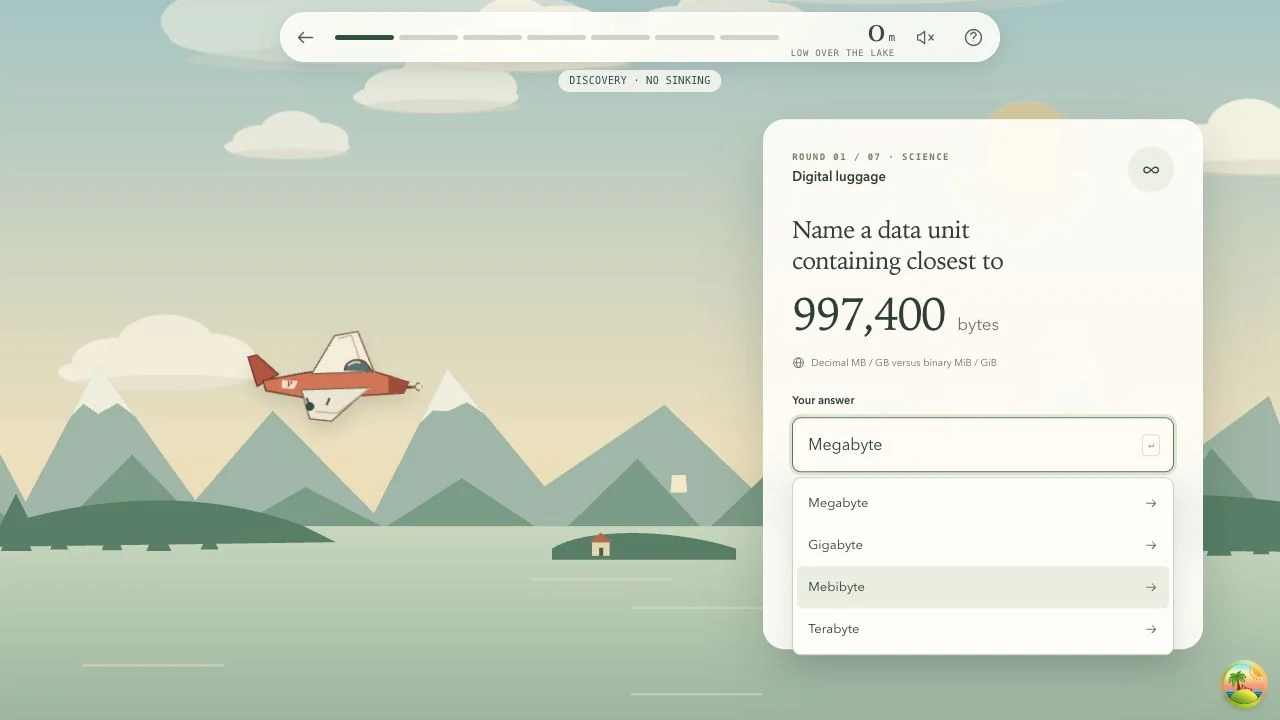
A useful guess starts with a unit and a reference point. Before trying to remember an exact fact, decide whether the answer belongs in the tens, hundreds or thousands. Then narrow it using something you know. In estimation games, that gives you a reason for your answer—and something specific to improve after the reveal.
This guide uses Plain Game, our free browser game, for its worked examples. Its scoring rewards closeness, with a different rule for calendar years. Other games may score differently, so check their rules before applying a strategy.
Read the unit before searching your memory
A familiar name can still produce a poor guess if you use the wrong measurement. A film's running time in minutes differs from its release year. Total country area differs from land area. A planet's diameter differs from its distance from the Sun.
Make your first check a sentence: “I need a name whose measurement, in units, is close to this target.” For a numerical question, replace “a name” with “a number.” This takes little time and makes a thousand-fold unit mistake easier to catch.
Plain Game's sources guide lists the collection scopes. Read the scope beside the actual prompt too: the same subject can support several different questions.
Build a small set of reference points
Choose a few values you understand rather than trying to memorize a whole table. For time, one hour is 60 minutes and two hours are 120. A running-time target of 150 minutes is two and a half hours. That conversion helps you search your memory for a long film, rather than guessing a title with no scale in mind.
For name rounds, a reference is a way to select a candidate; you must still know or estimate that candidate's value. For numerical rounds, you can enter your estimate directly. Do not confuse these two jobs.
When a reveal surprises you, keep one useful reference point from it. Before treating a game value as a general fact, check its definition and source. Plain Game uses frozen references, and some measurements are approximate.
Think in ratios when the score uses ratios
Consider an illustrative target of 100. An answer of 50 is half the target; 200 is twice it. Plain Game awards both 25 base points. An answer of 110 earns 83. These results follow the current scoring formula, not a claim that all estimation games use the same method.
That symmetry changes how you compare candidates. For a target of 100, candidates at 60 and 150 are 40 and 50 units away. Yet 150 is closer by ratio: 1.5 times the target, compared with 100 / 60, or about 1.67. The game awards 44 and 36 base points respectively. Choosing solely by the smaller absolute gap would miss that distinction.
Use this as a rough mental check: “Is my candidate about half, roughly equal to, or twice the target?” You do not need logarithms during a timed round.
Calendar years are the exception. Plain Game scores the absolute number of years you are off, and only the exact year earns its Bullseye bonus. A year ten years away does not become a better guess because the calendar number is large.
Break an unknown number into manageable parts
If a question allows it, estimate smaller pieces and combine them. As an invented example, a room with roughly 12 rows and 8 seats per row holds about 96 seats. If one row is shorter, adjust the result rather than pretending the first multiplication is exact.
Grouping is also useful for visual counts; Math Is Fun's visual estimation lesson demonstrates grouping objects before estimating the total. Plain Game is primarily factual estimation, so not every question can be solved by counting groups. Use decomposition when you have a sensible model, and a known reference when you do not.
Balance a better answer against the timer
In timed Plain Game rounds, each accuracy point adds ten metres. After three free reading seconds, each second costs four metres of altitude. A short pause can pay off when it helps you choose a noticeably closer answer. It cannot help after the 30-second deadline: a timeout earns no accuracy points.
The first accepted answer locks in. If spelling is slowing you down, choose a suggestion. An unknown name does not spend the turn, but it does not stop the clock either. Avoid repeatedly submitting an ambiguous fragment while hoping it will turn into the name you meant.
Use the reveal to diagnose the mistake
Instead of only looking at your altitude, identify one cause:
| What happened? | What to try next |
|---|---|
| Your answer was off by a factor of ten or more | Check the unit and order of magnitude first |
| You chose a plausible object but its value was surprising | Keep it as a new reference, after checking its scope |
| Your answer was not recognized | Use the full name or a suggestion from the collection |
| You knew a good answer but ran out of time | Practise finding the category and input type sooner |
| Your points looked good but altitude was lower | Account for timed drift, rather than assuming the score is wrong |
A short practice routine you can repeat
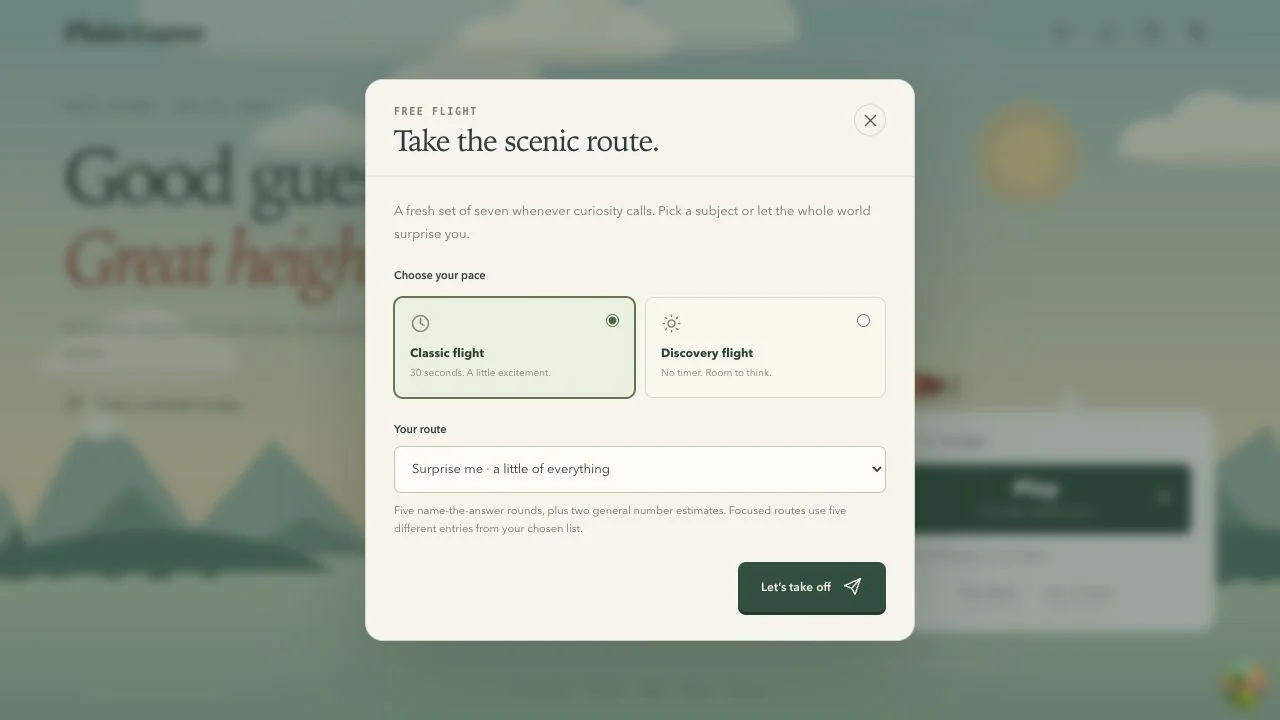
The Free flight menu in Plain Game. Choose a pace and a route before starting.
To practise estimation games without time pressure, open Plain Game, choose Free flight, and select the untimed Discovery pace. Pick a collection if you want to focus the five name rounds; the other two questions remain general numerical estimates.
For one seven-round flight, say your unit and reference point before answering. At each reveal, note one reason the estimate worked or missed. Finish the flight, then decide whether another untimed route or a timed practice flight would address the difficulty you noticed.
Return after New York midnight for the next daily challenge. Keep the same browser to preserve local progress, or use the game's export option for a backup. This routine offers a way to practise and reflect; it does not promise a particular score increase or broader learning outcome.